

Vintage apparel buying guide: find authentic US sportswear
TL;DR:
- Authentic vintage US sportswear has cultural, aesthetic, and financial value that reproductions lack.
- Key indicators of authenticity include RN numbers, era-specific labels, stitching, and fabric quality.
- Buying from trusted UK sources, verifying seller info, and understanding sizing ensures confident vintage collecting.
Buying authentic American vintage sportswear from the UK should be exciting, not a lottery. Too many collectors have opened a parcel expecting a genuine 1990s Champion NBA jersey, only to find a modern reissue or an outright fake. The sizing is wrong, the tags look suspicious, and suddenly that “bargain” feels anything but. This guide cuts through the noise. Whether you’re hunting a Starter jacket, an original Mitchell & Ness piece, or a deadstock MLB tee, you’ll learn exactly what to check, where to look, and how to build a collection that genuinely reflects your passion for US sports culture.
Table of Contents
- What to know before you buy: understanding authenticity and value
- Step-by-step: how to authenticate jerseys, jackets, and other staples
- Where to shop: the best places for UK buyers to find real deals
- Sizing, fit, and care: making vintage work for you
- Our take: why buying vintage US sportswear is about more than looks
- Find your next authentic piece with Gear & Glory UK
- Frequently asked questions
Key Takeaways
| Point | Details |
|---|---|
| Check labels and features | Era-specific tags, stitching, RN numbers, and zips help confirm garment authenticity. |
| Buy from trusted sources | Choose UK shops and online platforms with buyer protections for genuine vintage apparel. |
| Mind the sizing differences | Expect US vintage sizing to run larger than UK standards and verify with sellers. |
| Value condition and patina | Aged details raise the value and authenticity of vintage sportswear items. |
What to know before you buy: understanding authenticity and value
Authenticity isn’t just about bragging rights. A genuinely vintage piece carries cultural weight, holds or grows in value, and tells a story that no reissue ever can. For UK collectors, that distinction matters enormously, because the market is flooded with reproduction gear positioned to look vintage without any of the heritage behind it.
Why authenticity matters
Collectors and casual fans alike are drawn to vintage US sportswear for three interconnected reasons: collectibility, resale value, and irreplaceable style. A genuine 1994 Starter pullover jacket has a particular weight, texture, and colourway that modern factories simply do not replicate. The same goes for early 1990s Champion reverse-weave sweatshirts or authentic Rawlings baseball jerseys. Once you’ve handled the real thing, imitations feel hollow by comparison.
Beyond aesthetics, authentic vintage pieces hold genuine financial value. Rare items in excellent condition regularly sell for multiples of what a reproduction costs retail. Collectors who develop a trained eye early can source undervalued pieces and watch them appreciate significantly over time.
Key authenticity indicators to understand
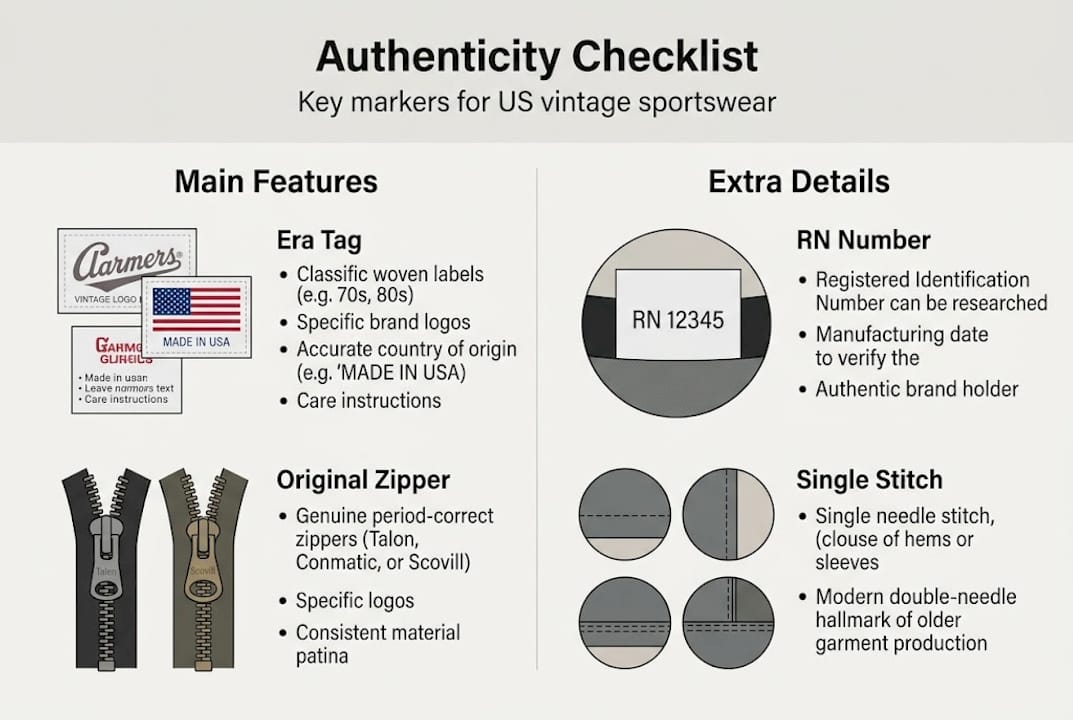
Authenticating vintage American sports clothing involves a specific set of checks that, once learned, become second nature. The most reliable indicators are:
- RN numbers: Registered Number codes printed or woven into US garment labels identify the manufacturer. You can cross-reference these against official databases to confirm the brand and approximate production era.
- Era-specific country of origin: Pre-1990s authentic US sportswear is typically labelled “Made in USA.” Items from the mid-1990s onward may show Honduras, El Salvador, or Mexico. A “Made in USA” label on a piece claiming to be from 2005 is an immediate red flag.
- Single-needle stitching: Older garments use single-needle stitching on side seams and hems, producing a tighter, less bulky seam than double-needle modern construction.
- Label fonts and printing styles: Each decade had distinct typographical conventions. Blurry printing, incorrect fonts, or overly crisp labels on supposedly aged garments suggest reproduction.
- Fabric weight and composition: Vintage cotton-polyester blends feel noticeably different from modern performance fabrics. Heavy, slightly coarse cotton is a good sign.
As the authentic gear guide explains, checking tags, labels, stitching, fabric weight, and manufacturer-specific details like RN numbers and era correct production countries is the foundation of solid authentication.
True vintage vs. modern reissues: a quick comparison
| Feature | True vintage | Modern reissue |
|---|---|---|
| Country of origin | USA, pre-2000 | China, Bangladesh, Vietnam |
| Stitching | Single-needle, tight | Double-needle, uniform |
| Label printing | Slightly faded, era-correct font | Crisp, modern typography |
| Fabric weight | Heavy, natural hand-feel | Lighter, synthetic feel |
| RN number | Traceable and era-consistent | Absent or inconsistent |
Pro Tip: Search the RN number printed on any label at the US Federal Trade Commission’s online database. If the number doesn’t correspond to the stated manufacturer or decade, walk away.
Step-by-step: how to authenticate jerseys, jackets, and other staples
With the basics covered, you’re ready to start authenticating. Here’s how to approach each item type with confidence and a methodical eye.
Jerseys
- Identify the manufacturer era. For vintage NFL brands and basketball, the manufacturer period is critical. Champion produced NBA jerseys between 1990 and 2002; Starter dominated NFL and MLB from the mid-1980s through the late 1990s. Any jersey claiming those manufacturers outside those windows warrants serious scrutiny.
- Inspect tackle-twill lettering. Authentic game-era jerseys feature tackle-twill, which means layered fabric letters stitched directly onto the jersey body. Each letter should have clearly visible stitch lines around its perimeter. Heat-pressed or screen-printed numbers are a major warning sign on pieces claiming to be authentic on-court or on-field jerseys.
- Check the stitched logos. Logos should be embroidered or stitched, never ironed on. Lift the logo gently. On genuine pieces, you’ll see clean backing fabric underneath. Reproductions often show a plastic film or adhesive residue.
- Look at the cut. Early 1990s NBA jerseys were cut shorter and wider than modern equivalents. NFL jerseys from the same era sit differently on the body. If the proportions feel contemporary, trust your instincts.
- Use a black light if in doubt. Modern whitening agents in newer fabrics fluoresce brightly under UV light. Genuine vintage cotton absorbs UV rather than reflecting it, producing a noticeably duller glow.
- Verify NHL jersey authentication specifics. Hockey jerseys have their own nuances, including CCM and Maska manufacturing details and specific crest attachment methods unique to different eras.
Jackets
“Vintage track jackets and bomber jackets with period zips (YKK, Talon), woven logos, and Made in USA/UK/Europe labels pre-dating the 1990s carry the highest collector value, and desirable patina only adds to that worth.”
For jackets, the zip is your first stop. YKK and Talon zippers were the industry standard on quality US sportswear through the 1980s and early 1990s. Both brands stamp their name on the zip pull. A generic, unmarked zip on a supposedly vintage Starter or Apex One jacket suggests the piece has been repaired, or worse, assembled from modern components. Woven logos, rather than embroidered patches, indicate an earlier production date on many collegiate and team jackets. Check that the weave pattern is consistent and that there are no signs of glue or heat application around the logo’s edges.
| Item type | Key authentication point | Red flag |
|---|---|---|
| NBA jersey | Tackle-twill letters, Champion label 1990-2002 | Screen-printed numbers |
| NFL jacket | Starter/Apex One label, YKK zip | Generic zip, modern cut |
| MLB tee | Single-needle seams, Rawlings/Russell tag | Double-needle, thin fabric |
| Track jacket | Woven logo, Talon/YKK zip, country label | Embroidered logo, no zip stamp |
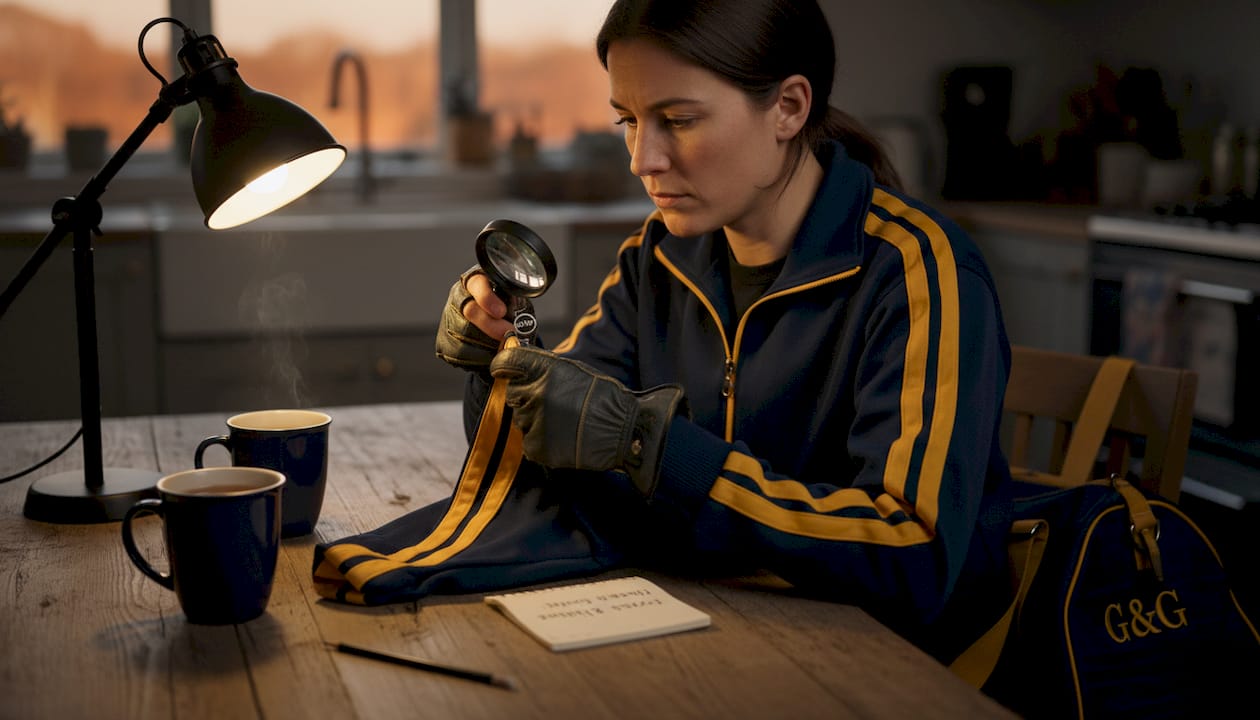
Pro Tip: A magnifying loupe (the small jeweller’s magnifier used to inspect coins) is worth every penny for reading tiny label text, checking stitch density, and spotting reproduction printing. They cost very little and fit in a jacket pocket.
Where to shop: the best places for UK buyers to find real deals
Now that you understand authentication, let’s focus on where UK collectors can actually find genuine pieces, without risking fakes.
Trusted sources for UK buyers
UK buyers sourcing authentic gear should prioritise specialist vintage shops, curated markets, and online marketplaces that offer genuine buyer protection. Recommendations from the vintage community consistently point to:
- Specialist bricks-and-mortar vintage shops in cities like London, Manchester, and Leeds, where staff have genuine product knowledge and the stock is pre-vetted before it hits the rails.
- Market stalls at established vintage fairs, including events run by Traid and similar organisations, where sellers build reputations over years and fraudulent stock rarely survives community scrutiny.
- Reputable online platforms such as Depop, eBay (using Buy It Now listings from sellers with verified feedback), and Grailed, provided you thoroughly examine the seller’s history and listed photos.
- Specialist US sportswear retailers based in the UK, which offer the combined advantage of authenticated stock, UK-based returns, and staff who genuinely understand what they’re selling.
How to vet any seller
Before committing to any purchase, request the following from a seller who hasn’t already provided them:
- Close-up photos of the full label, including country of origin and care instructions.
- Photos of the collar stitching, sleeve seams, and any logo or lettering application.
- A photo of the zip pull, showing any branding.
- Confirmation of their returns policy in writing.
Building your vintage jersey collection is much easier when you treat every purchase as a learning exercise. Keep records of what you bought, from whom, and at what price. Over time, you’ll recognise trustworthy sellers instantly and spot inconsistencies in others’ listings before you spend a penny.
Pro Tip: Join UK-based vintage sportswear communities on Discord and Facebook. The collective knowledge of experienced collectors is genuinely priceless. A quick post with a photo can save you from an expensive mistake within minutes.
Networks and word of mouth
Word of mouth remains the most reliable currency in vintage collecting. Understanding why iconic vintage jerseys hold such enduring appeal means recognising that the most knowledgeable sellers are often not the most visible ones. Ask questions at events, follow specialist accounts, and build relationships with sellers who share your enthusiasm for the genuine article.
Sizing, fit, and care: making vintage work for you
Finally, once you’ve sourced your pieces, knowing how to size, care for, and style them ensures lasting enjoyment and preserved value.
Getting the size right
US vintage sizing is notoriously different from UK conventions, and it catches collectors out regularly. The most widely cited rule of thumb is straightforward: a US medium fits UK large. This means if you normally wear a large in UK high street clothing, you should be looking at a US large or even XL in vintage American pieces, particularly from the 1990s when oversized silhouettes were the norm.
Check the NFL apparel guide for sport-specific guidance, because jersey cuts vary considerably across codes. NBA jerseys run long and narrow. NFL jerseys are boxy and drop low at the hem. MLB shirts follow a more traditional button-up cut that behaves like standard casual shirting. Always ask for exact measurements, specifically chest width, body length, and shoulder seam to shoulder seam, rather than relying on the label size alone.
Recognising wear: what to embrace and what to avoid
- Embrace: Light fading, cracking on screen-printed elements (on tees rather than jerseys), softened fabric, gentle collar distress. These are signs of genuine age and add character.
- Approach carefully: Small holes near collar or cuff seams, underarm discolouration that has set into the fabric, and any separation of tackle-twill letters.
- Avoid: Significant fabric thinning in high-stress areas, mould or mildew odour, and moth damage. These issues are extremely difficult and costly to reverse professionally.
Caring for your collection
Store vintage pieces folded rather than on hangers where possible, as heavy jerseys and jackets distort on standard hangers over time. Wash only when necessary, always using a cold, delicate cycle with a specialist gentle detergent. Turn jerseys and jackets inside out before washing. Never tumble dry. Air dry flat to preserve shape and prevent shrinkage in older cotton blends. For pieces of significant value, consider a professional dry cleaner experienced with vintage textiles.
Pro Tip: Cedar blocks in your storage space repel moths without the chemical smell of mothballs, which can permanently taint vintage fabrics. Replace them every few months for continuous protection.
Our take: why buying vintage US sportswear is about more than looks
Beyond the how-to, it’s worth reflecting on what makes authentic vintage so compelling for UK sports fans. We see this every day at Gear & Glory, and it’s something the mainstream fashion world tends to miss entirely.
Wearing a genuine 1993 Chicago Bulls champion tee isn’t a fashion statement in the conventional sense. It’s a declaration of cultural literacy. It says you understand the era, the significance of the team, and the history of the garment itself. That’s something a £30 fast-fashion reproduction simply cannot offer, regardless of how convincing it looks at a glance.
The hunt itself is part of the reward. Learning to read a label, spotting a genuine YKK zip, or identifying a Champion bar tag from across a market stall, these skills develop slowly and reward patience. They connect you to a community of people who care deeply about vintage NFL gear and US sports history in a way that no algorithm-curated online shop ever could replicate. True vintage style stands apart precisely because it requires genuine knowledge to pull off well.
Find your next authentic piece with Gear & Glory UK
Ready to take the next step? It’s never been easier to shop confidently for real US vintage pieces right here in the UK.

At Gear & Glory, every piece in our collection is selected for authenticity and quality. We stock verified US vintage apparel spanning NFL, NBA, MLB, and NHL, alongside modern Nike and Adidas gear, all shipped from our base in Market Deeping with UK-based returns you can rely on. Looking for something specific to complete your collection? Browse our range of authentic US sports caps and accessories to round out your look with pieces that have real provenance behind them. When you buy from us, you’re buying with confidence.
Frequently asked questions
How can I tell if US sportswear is genuinely vintage?
Check tags, labels, single-needle seams, RN numbers, and era-specific manufacturer details to confirm authenticity, since tags, labels, stitching, and RN numbers are the most reliable indicators of a genuine piece.
Where is the safest place to buy authentic vintage US sports gear in the UK?
Specialist vintage shops, trusted UK retailers, and reputable online marketplaces with clear return policies offer the best protection, as specialist shops and trusted UK sellers like Gear & Glory provide both authentication expertise and buyer security.
What US vintage jersey sizes match UK sizes?
A US medium fits UK large as a general guide, so always request exact chest and body length measurements before committing to a purchase.
What details add value to a vintage sports jacket?
Period zips (YKK, Talon), woven logos, a pre-1990s country of manufacture label, and genuine patina from natural wear all significantly raise the collector value of a vintage sports jacket.
Can UK buyers return vintage US sportswear if it’s not authentic?
Most reputable UK vintage retailers and major online marketplaces offer return policies covering inauthentic or misrepresented items, and sourcing from shops with returns is strongly recommended for any significant purchase.
Recommended
- How to identify authentic American sports apparel: UK guide – Gear&Glory UK
- What is authentic gear? The ultimate guide for UK fans – Gear&Glory UK
- Top vintage NFL brands for authentic American football style – Gear&Glory UK
- What is NFL apparel? a guide to authentic vintage sportswear – Gear&Glory UK